14 August 2026
The Longevity India Initiative at the Indian Institute of Science (IISc) hosted the second edition of RISE for Healthy Aging, its flagship conference on longevity and healthy aging, at the JN Tata Auditorium earlier this month. The two-day conference, held on 6–7 August, brought together nearly 800 participants and close to 60 speakers from India and abroad. The conference positioned India as an emerging voice in the global science of aging, with researchers, clinicians, technologists, and policymakers exploring how the country can extend healthspan and improve quality of life for its population.
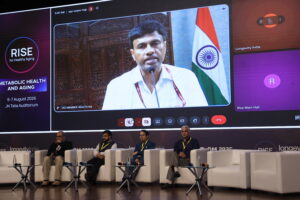
Inaugural address at RISE 2026: Dr M Srinivas (on screen); Seated (L to R): Dr Aravind Sosale, Diacon Hospitals; Prof Sathees C Raghavan, Dean, Division of Biological Sciences, IISc; Prof Navakanta Bhat, Dean, Division of Interdisciplinary Sciences, IISc and Prof Deepak Kumar Saini, Convener, Longevity India Initiative
Commenting on this year’s conference theme – metabolic health and aging – Mr Prashanth Prakash, Founding Patron, Longevity India Initiative, said: “This year, we picked metabolic aging as a central theme. Everyone is talking about GLP-1 drugs and what peptides are doing in this space, and we felt that it was important to bring metabolism to the forefront. As a country, we are going through a large-scale metabolic health epidemic, and we need unique Indian solutions to manage this crisis.”
As part of the inaugural session, Dr M Srinivas, Member, NITI Aayog and former Director of AIIMS, New Delhi, spoke about the need for a fundamental shift in Indian healthcare – from a system built around treating disease to one built around prevention, early intervention, and sustaining health across the lifespan.
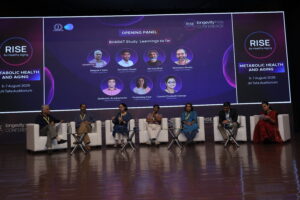
Panel Discussion on the BHARAT Study. L to R: Prof Deepak Kumar Saini (Convener, Longevity India Initiative, IISc); Prof Shantanu Shukla; Prof Prabhdeep Kaur; Prof Srimonta Gayen; Prof Ramray Bhat; Prof Siddharth Jhunjhunwala (Longevity Investigators); and Dr Carolin Elizabeth George (Bangalore Baptist Hospital)
The central theme of RISE 2026 was the need for aging research grounded in Indian populations, rather than imported wholesale from Western data sets. Sessions pointed to ongoing national efforts – including the BHARAT Study – as early steps toward mapping the biological signatures of aging specific to India, and closing long-standing gaps in global research. Sessions also traced advances in proteomics, high-resolution mass spectrometry, and next-generation diagnostics that are reshaping how aging is measured.
The scientific programme seamlessly moved from fundamental biology to translational science, with discussions spanning cellular metabolism, the genetics of aging and neurodegeneration, the gut microbiome, diagnostics, nutrition, reproductive health, and the economics of aging.
Sessions also underscored how aging, metabolism, reproduction, and lifestyle intersect, with dedicated discussions on menopause, gestational weight gain, metabolic disorders, and interventions across the life course.
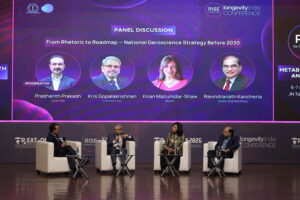
Panel Discussion on Geroscience Roadmap. L to R: Mr Prashanth Prakash, Dr Kris Gopalakrishnan, Dr Kiran-Mazumdar Shaw and Dr Ravindranath Kancherla
The conference also featured a panel discussion on charting a National Geroscience Roadmap for India, featuring Mr Prashanth Prakash, Dr Kris Gopalakrishnan, Dr Kiran Mazumdar-Shaw, and Dr Ravindranath Kancherla, who shared their perspectives on what it will take to build the field in the country.
Dr Kiran Mazumdar-Shaw, Patron, Longevity India Initiative, said: “India is a very young country today, but it is aging – we’re going to have 300 million people over the age of 60 by 2045. That’s why this symposium on longevity is so important: we need to start looking at India not just as a young country, but as a country that will soon start aging. Before that happens, we need to plan for healthspan, not just lifespan, so our people stay productive and healthy as they age.”
“My vision is that India must lead in longevity globally. We represent 20% of the world’s population, and I hope initiatives like Longevity India at IISc can build the leadership necessary – it will help our own people, and it will help the rest of the world,” said Dr Kris Gopalakrishnan, also a patron of the Longevity India Initiative.
Commenting on the conference, Dr Ravindranath Kancherla, Founder, Global Hospitals, said: “This is a very interesting conference because it represents a new science – geroscience, or longevity science. Until now, hospitals have largely been built to treat sick patients. This is a completely different paradigm: how do we optimise people’s health so that they live longer and healthier? There have been excellent discussions here, and a great deal to learn from one another.”
RISE 2026 was preceded by the Aging Biology and Regenerative Medicine Symposium on 5 August 2026 at IISc’s Division of Biological Sciences, where researchers from across India presented recent advances in aging biology and regenerative medicine – setting the stage for the broader conversations that followed at RISE.
This year, RISE partnered with Cure Trust to host TREAT-DM, a clinically focused conference on diabetes, on 8-9 August, immediately following RISE. Together, the two meetings brought researchers, clinicians, and industry leaders into a single four-day arc spanning the science of aging and metabolic disease – from foundational research to real-world clinical practice.
About Longevity India Initiative:
Longevity India, anchored by the Indian Institute of Science (IISc), serves as a unified hub for deep research, discovery, and pioneering technology development, driving advancements in healthy aging for India.
Website: https://www.longevity.iisc.ac.in/
Media Contact:
Mrunal Kulkarni (she/her)
Community Outreach Coordinator, Longevity India
Email: longevity@iisc.ac.in



