Accurately predicting ionic migration using machine learning
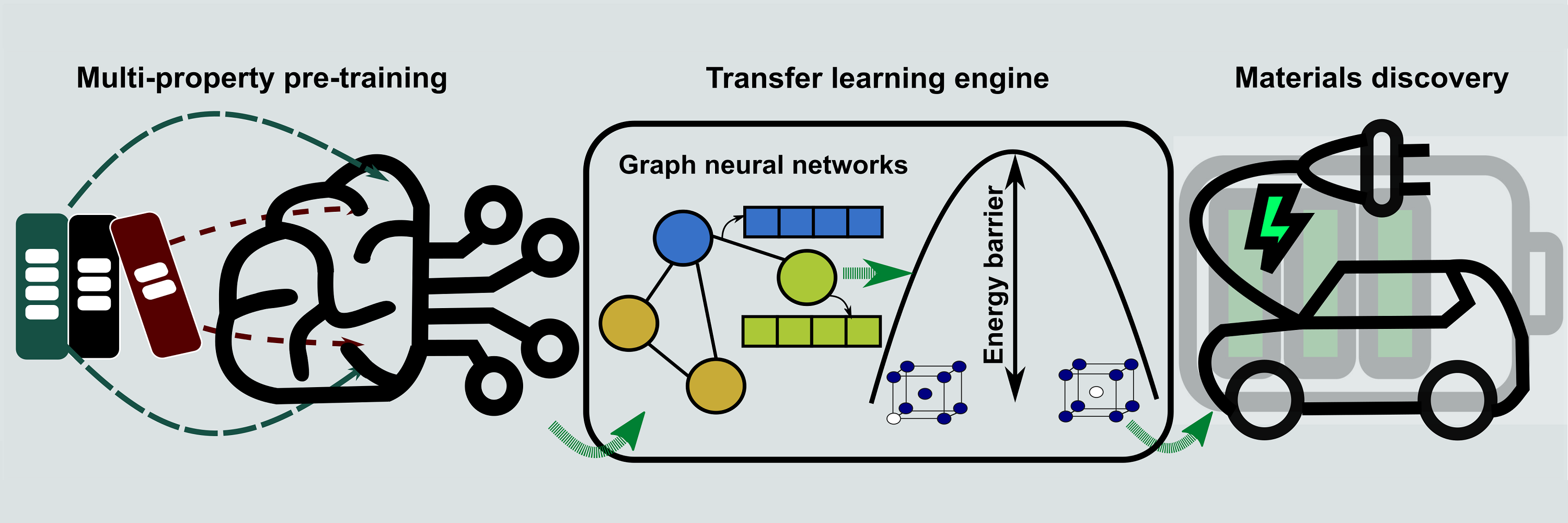
Ionic mobility – the ability of ions like lithium to move – in a given electrode or electrolyte material determines the rate performance of battery applications. In turn, the ionic mobility is exponentially controlled by the ionic migration barrier (E_m), which corresponds to the energy threshold that each ion has to cross as it moves from one site to another. Thus, if E_m can be swiftly and rapidly predicted across a diverse set of materials, we can identify electrodes and electrolytes that can enable rapid charge and discharge of battery systems.
However, E_m is a notoriously difficult quantity to measure or compute, given experimental challenges that are often material-specific and computational constraints on the cost and convergence of calculations. To overcome these challenges, researchers at the Department of Materials Engineering led by Sai Gautam Gopalakrishnan have constructed a graph-based neural network model. The model utilises the principles of transfer learning and introduces architectural modifications that are key to understand ‘direction of motion’ in a structure, in order to swiftly and accurately predict E_m across a diverse set of materials.
Specifically, the team trained the model on a manually curated dataset of 620 E_m values, across a wide range of materials, all computed with density functional theory based calculations. Importantly, their best-performing model achieved an R2 score of 0.703, a mean absolute error of 0.261 eV on the test set. It also showed the remarkable ability to generalise across migration directions, compositions in a structure, and diverse chemistries, and acted as an excellent classifier of good ionic conductors (classification accuracy of 80%).
This work, therefore, demonstrates an effective use of transfer learning strategies along with graph-based architectures to enable rapid screening and identification of materials that can improve the rate performance of both lithium-ion and beyond lithium-ion batteries.
REFERENCE:
Devi R, Butler KT, Gopalakrishnan SG, Leveraging transfer learning for accurate estimation of ionic migration barriers in solids, npj Computational Materials (2026).
https://www.nature.com/articles/s41524-026-01972-8
LAB WEBSITE:
https://sai-mat-group.github.io/



