R-ChFSI: An approximation-tolerant algorithm for large-scale eigenproblems”
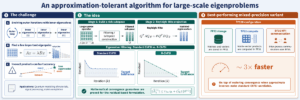
Large eigenvalue problems lie at the heart of computational science and engineering, arising across a broad range of applications, from simulating physical systems governed by partial differential equations to dimensionality reduction, graph analysis, and large-scale data science. These problems typically require computing a small but critical subset of the spectrum from very large matrices, and often demand repeated computation of eigenpairs as the matrix evolves within an outer iterative loop, making eigensolvers a persistent and dominant computational bottleneck.
The single most expensive operation in any iterative eigensolver is the matrix-vector multiplication, performed hundreds or thousands of times before convergence. What if these multiplications could be performed approximately, using cheap surrogate operators or reduced numerical precision, without sacrificing accuracy? Conventional eigensolvers provide no satisfactory answer, as approximation errors accumulate through the iterative procedure and cause convergence to stagnate well short of the desired accuracy.
Phani Motamarri and his team at the Department of Computational and Data Sciences, IISc, have now developed R-ChFSI (Residual-based Chebyshev Filtered Subspace Iteration) that answers this question affirmatively. The work was led by PhD student Nikhil Kodali in collaboration with fellow PhD student Kartick Ramakrishnan.
The key innovation lies in reformulating the matrix-vector multiplications involved in iteratively constructing a subspace rich in desired eigenvectors, to operate on residuals rather than eigenvector estimates directly. This ensures that approximation errors decay in tandem with the residual during convergence, preventing the accumulation of errors that causes conventional methods to stagnate. This property is rigorously established by mathematical convergence guarantees derived in this work.
Validated on large sparse eigenproblems arising in quantum modelling of materials with matrix sizes close to 100 million and tens of thousands of eigenpairs, R-ChFSI naturally accommodates multiple sources of approximation, including computation performed in FP32/TF32 precision, inter-node communication carried out in even lower precision, and approximate inverses for generalised eigenproblems.
The method achieves significant speedups over baselines with no approximations, as demonstrated on the Aurora exascale supercomputer using GPU accelerators. This work provides a practical pathway toward approximation-tolerant solvers, enabling accurate and scalable simulations on modern supercomputing architectures across a wide spectrum of applications in science and engineering.

REFERENCE:
Kodali N, Ramakrishnan K, Motamarri P, Residual-based Chebyshev filtered subspace iteration for Hermitian eigenvalue problems tolerant to inexact matrix-vector products, Computer Physics Communications (2026).
https://authors.elsevier.com/a/1nDKR2OInzR8b
LAB WEBSITE:
https://sites.google.com/view/matrix-lab



