When DNA’s traffic jam turns dangerous
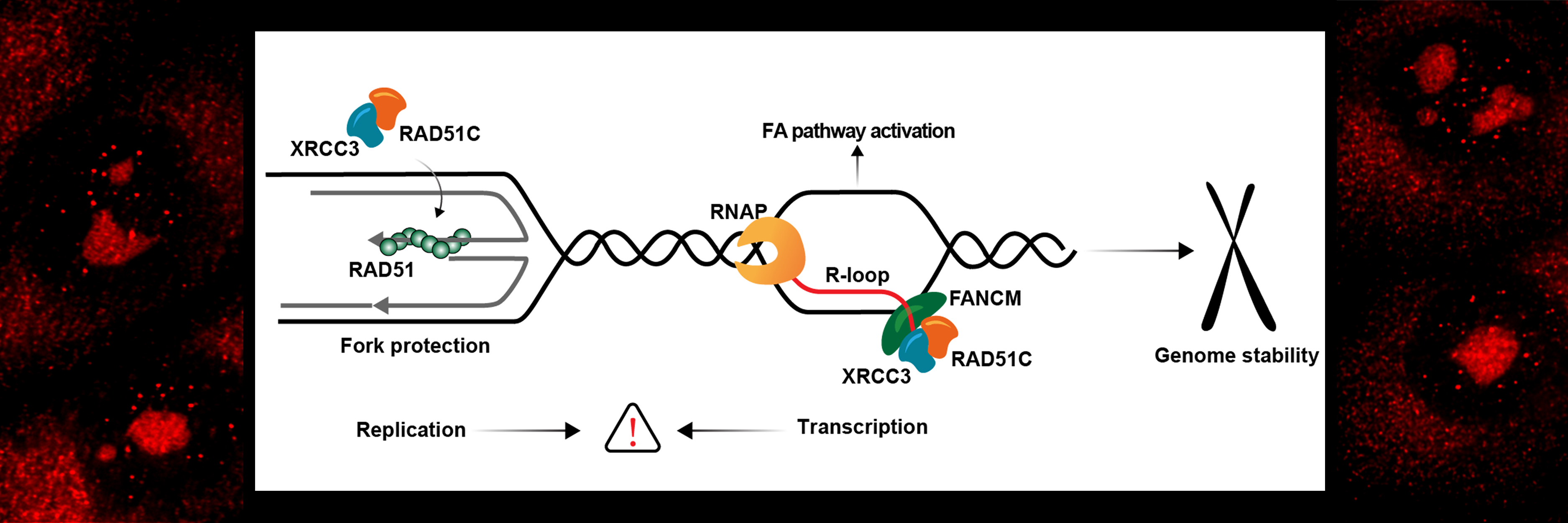
Fluorescent microscopy image of Human cells (HeLa) showing R-loops detected by S9.6 antibody and a model to explain the role of the CX3 complex in R-loop resolution to avoid transcription-replication conflicts and protect the genome (Image: Satyaranjan Sahoo)
Every second, the cells in our body copy their DNA while also reading it to make essential proteins. Both the replication (DNA copying) and transcription (DNA reading) machineries run on the same DNA template simultaneously. But imagine two trains running on the same track – collisions are bound to happen. Inside our cells, similar “traffic jams” can occur between the replication and transcription machineries, termed as transcription-replication conflicts (TRCs). These clashes can create harmful structures called R-loops – tangles formed when newly synthesised RNA reattaches to DNA.
If not properly cleared, R-loops can damage DNA, disrupt normal cell function, and increase the risk of diseases such as cancer and Fanconi anaemia (FA), a rare genetic disorder marked by bone marrow failure and cancer susceptibility.
In a new study published in Science Advances, researchers led by Ganesh Nagaraju, Professor at the Department of Biochemistry have uncovered an important safeguard against these dangerous DNA tangles. The team found that two proteins – RAD51C and XRCC3 – work together as a pair (the CX3 complex) to prevent harmful R-loop accumulation. When cells are depleted of the CX3 complex, harmful TRCs become more frequent, which leads to DNA breaks. While these proteins were already known for helping repair broken DNA, this study reveals a previously unknown role: they help recruit another protein, FANCM, to sites where R-loops form, allowing these structures to be safely resolved.
Importantly, a disease-linked mutation in RAD51C failed to properly interact with FANCM, leading to defective R-loop clearance. This finding helps explain how specific inherited mutations may contribute to Fanconi anemia (FA)–like disorders and cancer risk. By revealing how these proteins cooperate during active replication and transcription, this research provides deeper insight into how cells maintain genetic stability. In the long run, understanding these mechanisms could guide the development of new strategies for diagnosing or treating diseases linked to DNA damage and replication stress.

REFERENCE:
Sahoo S, Nagraj T, Bhattacharya D, Nagar N, Somyajit K, Poluri KM, Nagaraju G, RAD51C-XRCC3 complex regulates FANCM-mediated R-loop resolution to safeguard genome integrity, Science Advances (2026).
https://www.science.org/doi/10.1126/sciadv.aea5932
LAB WEBSITE:
https://biochem.iisc.ac.in/ganesh/



