Meditation strengthens gamma oscillations in the brain
– Ankan Biswas and Supratim Ray
Meditation is known to change brain oscillations – brain waves that neurons generate when they fire together at certain frequencies. Scientists had previously shown that slower oscillations such as theta (4-8 Hz) and alpha (8-12 Hz) have more power, or are stronger, in meditators. More recently, studies have shown that long-term meditators have higher power in the gamma range (30-80 Hz) as well. However, this elevated gamma-band activity is “broadband,” which means elevated power in a broad frequency range rather than appearing as a rhythm.
Simply viewing certain stimuli, such as oriented bars or black-and-white stripes called gratings, can induce oscillatory “narrowband” gamma oscillations in the visual cortex. Further, these stimulus-induced gamma oscillations weaken with ageing and the onset of some neurological disorders such as Alzheimer’s disease. But how meditation affects these gamma oscillations remains unknown.
To test this, researchers at the Centre for Neuroscience led by Supratim Ray partnered with Brahma Kumaris Rajyoga meditators, who meditate with open eyes. They performed electroencephalography (EEG) – a non-invasive method to record brain activity – on the subjects as they viewed gratings before, after, and during meditation. They compared 30 age- and gender-matched pairs of experienced meditators (averaging over 10,000 hours of practice) with non-meditators. They found that meditators had stronger stimulus-induced gamma than controls. They also displayed “broadband gamma” reported in previous studies, which was prominent across frontal, temporal, and parietal regions in the brain. These two gamma signatures were statistically unrelated, suggesting that meditation enhances separate neural mechanisms. Additionally, meditators showed a steeper aperiodic spectral slope – a feature that flattens with ageing – consistent with stronger inhibitory circuitry.
Overall, long-term meditation appears to strengthen neural dynamics that weaken with ageing, raising the possibility that sustained practice could help build resilience against neurodegenerative decline.
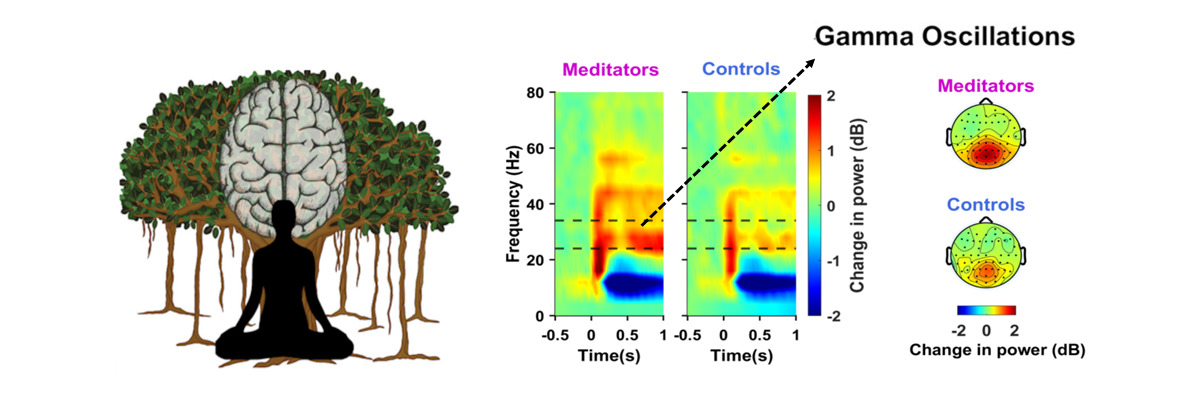
Long-term meditators have stronger gamma oscillations. The time-frequency spectrograms (middle panel) display brain activity across different frequencies (vertical axis) as it unfolds over time (horizontal axis), with the color indicating power – warmer colors (red) represent stronger activity. The strong reddish band between the dashed lines (~24–34 Hz) depicts stimulus-induced gamma, which is stronger in meditators (left) than matched controls (right). Topoplots (rightmost panel) show that gamma is stronger over visual brain areas (occipital cortex) for the meditators compared to the controls (Image: Ankan Biswas)
REFERENCE:
Biswas A, Aggarwal S, Sharma K, Ray S, Simultaneous enhancement of stimulus-induced and stimulus-free gamma in open-eye meditators, Imaging Neuroscience (2026).
https://direct.mit.edu/imag/article/doi/10.1162/IMAG.a.1145/135212
LAB WEBSITE: https://cns.iisc.ac.in/sray/
PROJECT WEBSITE: https://sites.google.com/view/projectdhyaan



