2 July 2026
Oral cancer is a major health challenge in India, where tobacco and areca nut use contribute substantially to the disease burden. Despite advances in surgery, chemotherapy, and radiotherapy, treatment remains difficult because current approaches can damage healthy tissues along with cancer cells, often affecting patients’ quality of life.
In a new study, researchers at the Indian Institute of Science (IISc), in collaboration with clinicians at MS Ramaiah Medical College and Hospitals, explored whether low-frequency ultrasound mechanical stimulation could selectively kill oral cancer cells. The team worked with patient-derived oral tumour samples that better reflect variations among Indian patients.
The team found that oral cancer cells are surprisingly vulnerable to the moderate mechanical stimulations produced by ultrasound. This vulnerability appears to arise from reduced levels of Tropomyosin 2.1, a mechanosensory protein that helps body cells sense and withstand physiologically relevant mechanical stimulation. When exposed to ultrasound-driven mechanical stimulation, oral cancer cells underwent selective cell death, while healthy oral epithelial cells remained unharmed.
“The novelty of this study lies in showing how ultrasound mechanostimulation can selectively target oral cancer cells by exploiting their mechanical weakness,” says Ajay Tijore, Assistant Professor at the Department of Bioengineering, IISc, and corresponding author. “Instead of using heat or drugs, this approach uses moderate mechanical forces to damage cancer cells beyond their ability to recover.”
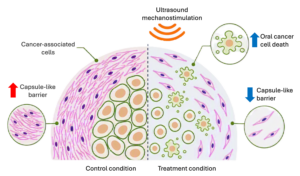
Ultrasound mechanostimulation-mediated killing of oral cancer cells and compromised integrity of the capsule-like barrier (Image: Rashmita Luha)
The team also found that ultrasound drastically reduces the cancer cells’ ability to migrate and invade surrounding tissue. Intriguingly, using a 3D co-culture platform that mimics the oral tumour microenvironment, the team found that ultrasound disrupted the dense capsule-like barrier formed by cancer-associated cells around the tumour core. Such barriers prevent drugs and immune cells from reaching the tumour core, resulting in treatment failure.
“What surprised us most was the consistency of the response across cancer cells derived from multiple patients from different cancer stages. They were highly vulnerable to ultrasound, while normal cells were much less affected,” says Rashmita Luha, PhD student in the Department of Bioengineering and first author.
Since ultrasound is non-invasive and already approved for various medical uses, these findings suggest that ultrasound mechanostimulation could exploit the mechanical weakness of oral cancer cells. With further validation in advanced preclinical models, this approach may help develop safer, more targeted treatment strategies for oral cancer and potentially other easily accessible cancers such as breast and skin cancers.
“The clinical collaboration was very important because it allowed us to work with patient-derived oral tumour samples rather than relying only on standard cell lines developed in Western countries,” says Tijore. “In the future, we want to test this approach in more physiologically relevant models and explore whether ultrasound can be combined with existing treatments to improve drug penetration and therapeutic outcomes.”
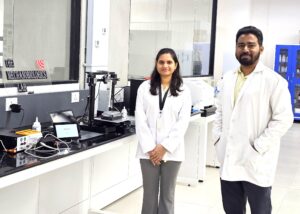
Rashmita Luha (left) and Ajay Tijore (right) (Photo: Siddhesh Saigaonkar)
REFERENCE:
Luha R, Sankar G, Kumar A, Kumari A, Kulkarni K, Pratap R, Kapali A, Tijore A, Revealing biomechanical vulnerabilities in oral cancer cells using 3D coculture platform and low-frequency ultrasound, Materials Today Bio (2026).
https://www.sciencedirect.com/science/article/pii/S2590006426006204?via%3Dihub
CONTACT:
Ajay Tijore
Assistant Professor
Department of Bioengineering (BE)
Indian Institute of Science (IISc)
Email: ajaytijore@iisc.ac.in
Phone: +91-80-2293-3752
Website: http://tijorelab.com
NOTE TO JOURNALISTS:
a) If any of the text in this release is reproduced verbatim, please credit the IISc press release.
b) For any queries about IISc press releases, please write to news@iisc.ac.in or pro@iisc.ac.in.



