30 July 2026
Researchers at the Indian Institute of Science (IISc) have demonstrated a new way of switching a material between two fundamentally different magnetic states using an electric current. The discovery could pave the way for compact, energy-efficient electronic devices that store information, perform logic operations, and even interface with future quantum computers.
Published in Nature Communications, the work was led by Bhagwati Prasad, Assistant Professor in the Department of Materials Engineering, together with first author Suryakanta Mondal, PhD student, and a team of national and international collaborators.
Many magnetic memory technologies rely on changing the direction of a material’s magnetisation. In this study, however, instead of simply flipping the direction of magnetisation, the team used an electric current to completely transform the material from one magnetic state to another.
The researchers studied a complex oxide called Sm₁₋ₓSrₓMnO₃ which is known for hosting multiple magnetic states. “Our initial motivation was to understand whether the closely competing magnetic states could be controlled directly using an electrical current,” explains Mondal.
At low current, the material exists in a ferromagnetic state in which its atomic magnetic moments are largely aligned in the same direction. In this state, electric current flows easily and resistance is low. But when the applied current crossed a critical value, the material abruptly switched to an antiferromagnetic-like state in which neighbouring magnetic moments tend to point in opposite directions. This state has much higher electrical resistance.
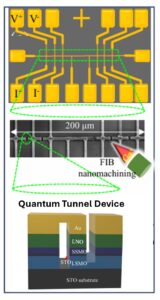
Current-controlled orbital reconstruction drives a transition from ferromagnetic to antiferromagnetic order in a complex oxide and associated quantum-tunnel device (Image: Suryakanta Mondal)
The team demonstrated that this electrically-driven transition is reversible and is accompanied by the collapse of long-range ferromagnetic order and a rearrangement of the material’s electronic orbitals. This makes the switch different from ordinary heating or conventional current-driven reversal of magnetisation.
“What is fundamentally new is that the electric current does not merely rotate the magnetisation; it changes the magnetic phase of the material itself,” says Prasad. “This gives us two clearly distinguishable resistance states that may be useful for cryogenic memory and logic technologies.”
The researchers then used the material to fabricate nanoscale tunnel devices measuring about 250 by 250 nanometres in size. These miniature devices displayed two stable resistance states, with magnetoresistance exceeding 200%. The switching could be controlled by electric current, temperature, and magnetic field.
Because the effect is strongest at low temperatures, the discovery is particularly promising for cryogenic memory and logic circuits that can support quantum computing platforms, which typically operate at extremely low temperatures.
The researchers now plan to work on reducing the current and energy required for switching, adapting the device for a wide range of operating temperatures, and integrating these devices into larger cryogenic memory and logic circuits. This could potentially lead to a new generation of low-power electronic and quantum devices.
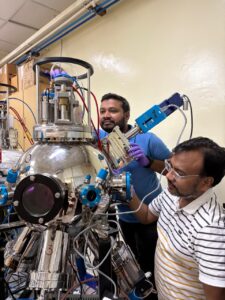
Bhagwati Prasad (right) and Suryakanta Mondal (left) in the DEMAND Lab, where the experimental work leading to this discovery was primarily carried out (Photo: Uma Ganguly)
REFERENCE:
Mondal S, Kumar V, Chowdhury S, Godha A, Mandal AK, Tang W-S, Kalitsov A, Omar A, Nandy S, Dey JK, Panchal G, Makineni SK, Mundy J, Tang Y-H, Manipatruni S, Bibes M, Blamire M, Prasad B, Electrically driven inverse metamagnetic transition in Sm₁₋ₓSrₓMnO₃, Nature Communications (2026).
https://www.nature.com/articles/s41467-026-75886-w
CONTACT:
Bhagwati Prasad
Assistant Professor
Department of Materials Engineering (MatE)
Indian Institute of Science (IISc)
Email: bpjoshi@iisc.ac.in
Phone: +91-80-2293 2679
Website: https://www.demandlab-iisc.com/
NOTE TO JOURNALISTS:
a) If any of the text in this release is reproduced verbatim, please credit the IISc press release.
b) For any queries about IISc press releases, please write to news@iisc.ac.in or pro@iisc.ac.in.



