Unravelling tumours, layer by layer
– Anjalika Das
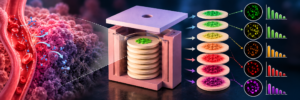
A simple, 3D-printed press-fit device for the fabrication of in vitro 3D tumor tissues that recreates diffusion-limited microenvironments and allows layer-by-layer analysis of cell viability and anticancer drug response (Image: Bhushan Toley/AI-Assisted Artwork)
What do sci-fi movies and cancer research have in common? Both are better in 3D!
Studying cancer, especially solid tumours, remains challenging mainly because mimicking the tumour microenvironment and its heterogeneous cellular composition in the lab is tough. However, researchers have recently developed gel matrices to grow tumours in 3D successfully, which has brought them closer to reality.
One such platform is the Cells-in-Gel-in-Paper (CiGiP), in which cells are cultured on stacked papers. To spatially confine cell-containing media and extracellular matrix within the paper platform, researchers would use solid-ink printers to print hydrophobic or wax patterns as barriers. However, such printers are no longer in use, leaving researchers with no way to effectively recreate the barriers needed to replicate the layered tumour architecture.
To overcome this obstacle, a team at the Department of Chemical Engineering, IISc, led by Bhushan Toley, has developed a 3D-printed press-fit enclosure device that mechanically constrains the stacked cell-containing paper layers without the need for wax barriers. The device, designed by Ankit Kumar, a PhD student in Toley’s lab, can be easily made with cost-effective FDM 3D printers. An inlet at the top brings in culture media, creating a gradient of nutrients, oxygen, and carbon dioxide across the paper layers, similar to solid tumours encased by blood vessels on the surface. Conveniently, the paper layers can also be destacked, allowing researchers to extract individual layers and study them separately.
Using breast cancer cells, the team was able to observe several tumour characteristics being recapitulated in their model, such as an increase in hypoxia and cell death, and a decrease in drug uptake in lower layers. The system also confirmed earlier reports that two popular chemotherapy drugs, doxorubicin and paclitaxel, work antagonistically when used in combination.
By eliminating the need for hydrophobic patterning, this device offers a promising cancer cell culture model that can help researchers study how well drugs penetrate and act on solid tumours.
REFERENCE:
Kumar A, Kumar S, Toley BJ, Wax-printing-free fabrication of paper-supported 3D cancer cell culture, Analytical Methods (2026).
https://doi.org/10.1039/d6ay00724d
LAB WEBSITE: https://toleylab.weebly.com/



