Peers over the past

Photo: Kanika Rawat
Animals don’t just respond to what’s happening around them right now. They also carry memories of past danger. An individual that grew up in a risky environment tends to remain cautious even later in life, a phenomenon called “behavioural carryover” of risk experience. Understanding this is important for predicting how animals adapt and survive. But do animals simply replay past experiences, or do they integrate current information to show flexibility in how that carryover plays out?
Researchers at the Centre for Ecological Sciences, IISc, addressed this by focusing on the pupal stage of Aedes aegypti, the mosquito species responsible for transmitting many diseases. In earlier work, they showed that larvae exposed to predators carried that “wariness” into their pupal stage when alone. However, pupae in nature are rarely alone, so the team also observed them in groups. They asked: Does the company of peers change how past experiences shape behaviour (expecting that individuals may feel safer in a group and no longer need to show behavioural carryover)?
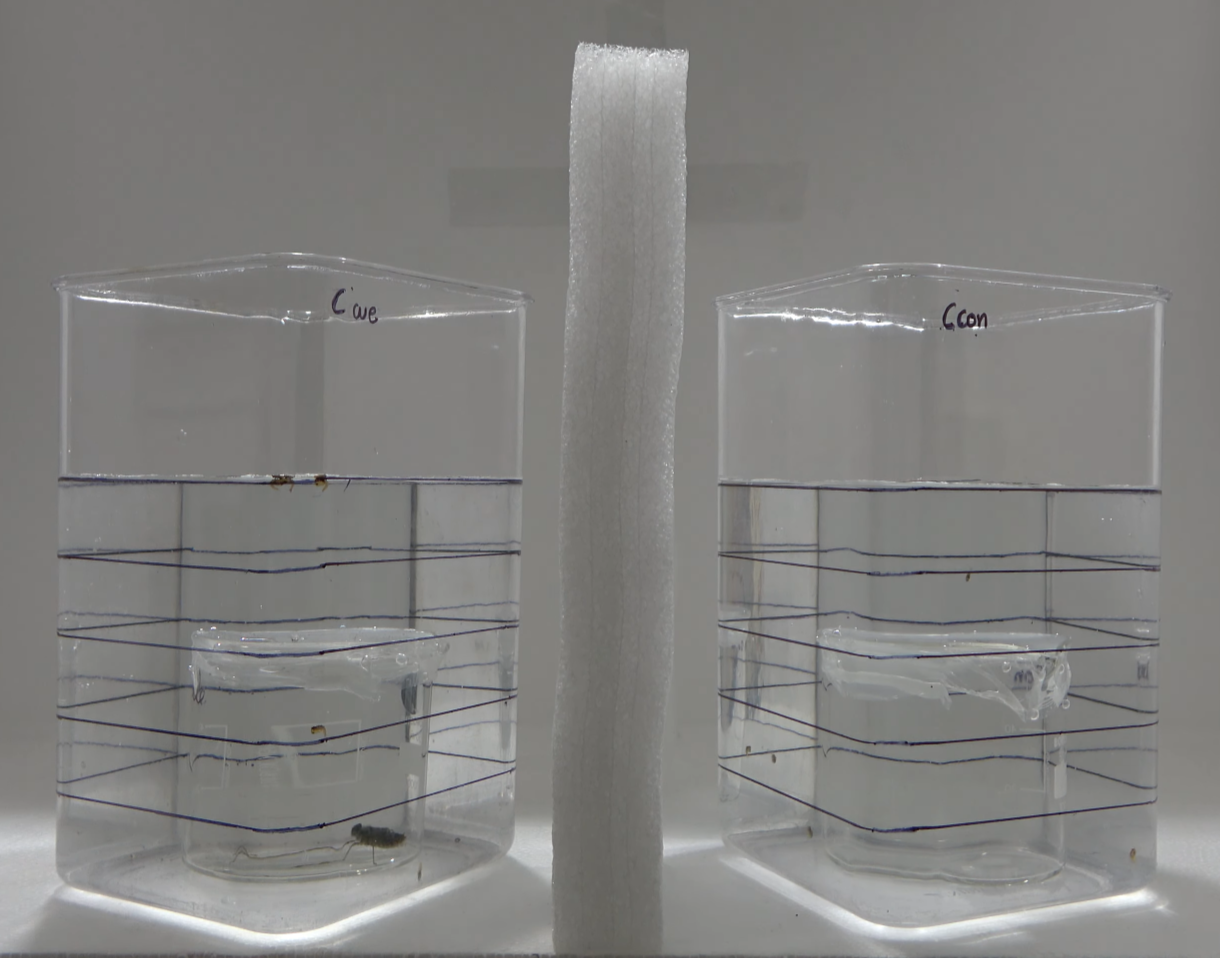
Experimental setup: Left tank (threat condition) contained predation-cue water and a dragonfly nymph enclosed in a sealed glass beaker; the right tank (no-threat condition) contained plain water only (Photo courtesy: Kanika Rawat)
Indeed, when the team placed risk-experienced individuals in groups, their “caution” essentially disappeared. They behaved like individuals that had never encountered a predator. This indicates that past experience does not rigidly dictate future behaviour.
What makes this striking is that it occurs during the pupal stage, a brief 2-3 day window in which the animal neither eats nor reproduces, undergoes complete internal transformation, and still integrates past and present ecological information. These findings reveal that survival responses are remarkably flexible, even in the most fleeting life stages.
REFERENCES:
Rawat K, Isvaran K, Peers over the past: prior predation-risk experience does not dictate antipredator responses of individuals in groups, Biology Letters (2025).
https://doi.org/10.1098/rsbl.2025.0806
Rawat K, Bhambore AA, Isvaran K, Don’t leave the past behind: larval experience shapes pupal antipredator response in Aedes aegypti, Behavioral Ecology (2025).
https://doi.org/10.1093/beheco/araf001
LAB WEBSITE:
https://sites.google.com/view/kilab



